


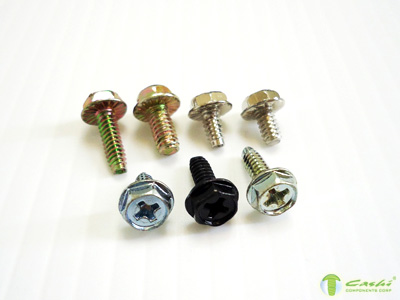
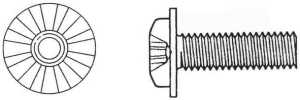
Integrated Serrations Under the Screw Head
The anti-loosening serrations are formed directly beneath the screw head or flange surface, eliminating the need for a separate serrated washer. This helps reduce the number of components and avoids problems such as missing washers, dropped parts, or incorrect specification matching.
Serrated Surface Provides Auxiliary Anti-Loosening Performance
After tightening, the serrations engage with the workpiece surface and increase frictional resistance at the contact area. This creates greater resistance against reverse rotation and helps reduce loosening caused by general vibration or equipment operation.
Actual anti-loosening performance should still be evaluated according to serration design, tightening torque, workpiece material, surface hardness, and vibration conditions.
Reduces the Need for Additional Washers
Because the locking structure is integrated into the screw head, serrated washers or other auxiliary components may be reduced in certain product designs, helping simplify the overall assembly structure.
Whether a washer can be omitted should still be confirmed according to hole diameter, workpiece thickness, contact area, and load requirements.
Simplifies the Assembly Process
The screw can be installed directly without separately handling, orienting, or positioning a serrated washer. This helps reduce manual assembly steps and shorten assembly time.
Reduces the Risk of Missing or Dropped Components
Because the serrations are integrated with the screw, there is no separate washer that can be omitted or dropped during transportation, material handling, or production-line assembly.
Suitable for High-Volume Production and Automated Fastening
The one-piece design is suitable for vibratory bowl feeding, track feeding, and automatic screw-fastening equipment. It helps reduce overlapping, flipping, jamming, and orientation errors that can occur with separate washers.
Actual feeding stability should still be tested according to screw head type, dimensions, length, and equipment specifications.
Serrated Flange Design Increases Contact Area
When a flange-head design is used, the wider flange increases the contact area between the screw and the workpiece, helping distribute fastening pressure. Serrations beneath the flange add gripping action, allowing a single structure to provide both support and auxiliary anti-loosening performance.
All-Metal Structure for a Wider Range of Applications
W/SERRATED screws generally use an all-metal one-piece structure without nylon or rubber components. This makes them more suitable for environments where temperature, oils, aging, or chemical exposure must be considered.
Actual temperature resistance, corrosion resistance, and chemical resistance still depend on the screw material and surface treatment.
Serration Direction Can Be Designed According to Rotation
The serration profile can be designed according to the tightening and loosening direction of the screw, allowing relatively smooth tightening while creating greater resistance during reverse rotation. Actual serration direction should be confirmed according to thread direction and operating conditions.
Multiple Head Types and Serration Designs Available
Hex heads, flange heads, pan heads, and other head types can be combined with different serration counts, tooth heights, tooth angles, and arrangements according to installation tools, appearance, available space, and anti-loosening requirements.
Customization Based on Drawings and Samples
W/SERRATED screws can be customized according to customer engineering drawings or physical samples, including screw head type, drive type, thread diameter, thread pitch, length, serration profile, material, strength, tolerances, heat treatment, and surface treatment.
Common Applications
W/SERRATED screws are commonly used in:
- Machinery and automation equipment
- Automotive and motorcycle components
- Electronic and electrical equipment
- Enclosures, cabinets, and sheet metal structures
- Motors, fans, and transmission equipment
- Agricultural and gardening machinery
- Home appliances and consumer products
- Furniture and general hardware
- Assemblies exposed to vibration or repeated operation
- Mass-production and automated fastening lines
Key Considerations When Selecting W/SERRATED
Before selection, confirm the screw thread diameter, thread pitch, length, head type, and drive type. The appropriate serration structure should also be selected according to the workpiece material, hole diameter, contact area, and available installation space.
The serrations must make sufficient contact with the workpiece surface to provide the intended gripping effect. If the workpiece is too hard, the contact surface is uneven, or the coating is too thick, the serrations may not engage effectively and anti-loosening performance may be reduced.
The serrations may leave marks on the workpiece surface and can damage paint, plating, or other protective coatings. If appearance, sealing performance, or corrosion resistance is important, the effect of the serrated surface should be evaluated in advance.
If the serrations penetrate a corrosion-protection coating, the contact area may become more susceptible to corrosion. Surface treatment, sealing methods, and additional corrosion protection should therefore be evaluated according to the operating environment.
W/SERRATED is an auxiliary anti-loosening design. For applications involving severe vibration, heavy impact, high loads, or safety-critical structures, serrated engagement alone should not be relied upon. Thread-locking compounds, lock nuts, mechanical locking devices, or other suitable anti-loosening methods should also be considered.
When reusing the screw after removal, inspect the serrations for wear, flattening, missing teeth, or deformation. If the serrated surface can no longer effectively engage the workpiece, replacement with a new component is recommended.


