


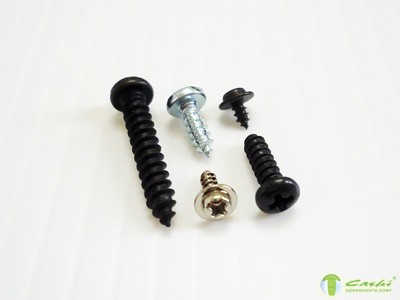
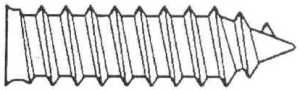
Sharp Point Helps with Fast Positioning
The sharp point can enter the workpiece hole or material surface first, helping position the screw and reducing slipping, misalignment, or difficulty locating the hole during the initial fastening stage.
For smooth metal surfaces or applications requiring precise hole positioning, fixtures or pre-drilled pilot holes should still be used.
Improves Initial Screw Engagement
The sharp point reduces the initial contact area between the screw tip and the workpiece, allowing the screw to enter the pilot hole more easily and helping the threads gradually engage with the hole wall.
Actual lead-in performance depends on point angle, workpiece material, hole diameter, and applied downward force.
Forms Internal Threads in the Workpiece
When driven into a properly sized pilot hole, TYPE-AB can use its own threads to cut or displace the hole wall and form internal threads that mate with the screw, reducing the need for a separate tapping operation.
May Reduce Pre-Drilling for Some Materials
For thinner, softer, or easily penetrated materials, certain TYPE-AB specifications may be able to enter the workpiece directly, reducing the need for a separate positioning or pilot hole.
TYPE-AB is not the same as a self-drilling screw. For thicker or harder metal workpieces, a suitable pilot hole is generally still required.
May Eliminate the Need for a Separate Nut
The screw can engage directly with the internal threads formed in the workpiece, making it suitable for one-sided assembly, structures where rear-side nut installation is not possible, or products with limited internal space.
Suitable for Fast Assembly of Thin Sheet Materials
The sharp point and self-tapping thread can be used for fastening thin metal sheets, enclosures, housings, and sheet-metal parts, reducing the need for separate nuts, pre-tapping, and multi-component assembly.
The suitable sheet thickness should still be confirmed according to screw thread diameter, thread pitch, material hardness, and effective thread engagement.
Suitable for Plastics and Wood
TYPE-AB screws with coarse or deep threads can be used with plastic components and wooden products according to material characteristics. The sharp point assists initial penetration, while the threads engage with the surrounding material.
For plastic applications, boss dimensions, pilot hole size, and tightening torque should be controlled to avoid stress whitening or cracking.
Simplifies Tapping and Assembly Processes
Once the specified hole is prepared, TYPE-AB can complete initial engagement, internal thread formation, and component fastening in the same operation, reducing separate tapping and nut-installation processes.
Multiple Thread and Head Designs Available
Depending on workpiece material, installation tools, appearance, and fastening requirements, TYPE-AB can be designed with single-start, twin-start, coarse, or fine threads, together with pan heads, countersunk heads, hex heads, and other head types.
Suitable for Automated Fastening
TYPE-AB screws with consistent specifications can be used with vibratory bowls, feeding tracks, and automatic screw-fastening equipment. The sharp point can also assist alignment with the positioning hole.
During automated fastening, screw perpendicularity, rotational speed, downward force, and shut-off torque should still be properly controlled.
Multiple Materials and Surface Treatments Available
Depending on strength, rust resistance, corrosion resistance, and operating environment, carbon steel, alloy steel, or stainless steel can be selected together with zinc plating, nickel plating, black oxide, phosphate coating, passivation, or other surface treatments.
Customization Based on Drawings and Samples
TYPE-AB screws can be customized according to customer engineering drawings or physical samples, including screw head type, drive recess, thread diameter, thread pitch, overall length, point angle, point length, material, hardness, tolerances, heat treatment, and surface treatment.
Common Applications
TYPE-AB screws are commonly used in:
- Thin metal sheets and sheet metal structures
- Metal enclosures, cabinets, and housings
- Electronic and electrical equipment
- Home appliances and consumer products
- Plastic housings and engineering plastic components
- Wooden furniture and decorative hardware
- Automotive and motorcycle components
- Telecommunications and information equipment
- Aluminum alloy and zinc alloy die-cast parts
- Ventilation ducts and HVAC equipment
- One-sided assembly locations or areas where rear-side nut installation is difficult
- Mass-production and automated fastening lines
Key Considerations When Selecting TYPE-AB
Before selection, confirm the workpiece material, hardness, thickness, hole diameter, effective engagement depth, and expected load. The appropriate point angle, thread profile, and screw hardness should be selected according to the material conditions.
TYPE-AB and self-drilling screws serve different functions. The sharp point is mainly intended for positioning, lead-in, and penetration of thinner or softer materials. It does not provide the same chip-clearance grooves or drilling capability as a drill-point screw. Thicker or harder metal workpieces generally require a pre-drilled pilot hole.
If the pilot hole is too small, driving torque may become excessively high, potentially causing point deformation, screw breakage, drive recess damage, or workpiece cracking. If the pilot hole is too large, thread engagement may be insufficient, resulting in free spinning, thread stripping, or reduced pull-out strength.
For thin metal sheet applications, sufficient effective thread engagement should be confirmed. If the sheet is too thin or tightening torque is excessive, the hole may enlarge, the sheet may deform, or the screw may spin without tightening.
For plastic applications, the boss outside diameter, wall thickness, pilot hole depth, and material properties should be confirmed. An excessively long point may contact the bottom of the hole or internal components, while an oversized screw diameter may cause boss expansion or cracking.
Because the point is sharp, appropriate care should be taken during handling, packaging, and manual assembly to avoid puncture injuries. If the product is used in an area accessible to personnel, it should also be confirmed that the sharp point does not protrude through the back of the workpiece.
Fastening tools should be set to appropriate rotational speed, downward force, and shut-off torque. Before mass production, driving torque, tightening torque, stripping torque, failure torque, and pull-out strength should be tested to confirm that the selected thread profile and fastening parameters provide an adequate process safety margin.


