


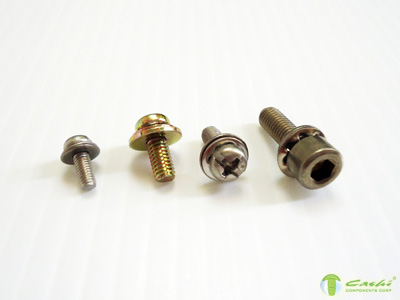
Pre-Assembled Screw and Washer
The internal-tooth flat washer is installed and retained on the screw during production, eliminating the need to prepare or position the washer separately during assembly. This helps reduce assembly steps and improve operating efficiency.
Provides Both Support and Auxiliary Anti-Loosening Functions
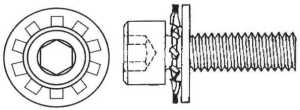
The outer portion of the internal-tooth flat washer provides a flat supporting surface that helps distribute fastening pressure, while the internal teeth around the center hole increase friction and gripping action at the contact surface. This allows a single washer to provide both support and auxiliary anti-loosening functions.
Internal Teeth Increase Frictional Resistance
After tightening, the internal teeth deform elastically and engage with the underside of the screw head and the workpiece surface, helping reduce rotational loosening under general vibration or equipment operating conditions.
Actual anti-loosening performance should still be evaluated according to tightening torque, workpiece material, surface hardness, applied load, and vibration level.
Helps Distribute Fastening Pressure
The flat supporting area increases the contact area between the screw head and the workpiece, allowing fastening force to be distributed more evenly and reducing the possibility of indentation or localized deformation around the mounting hole.
Actual performance will still depend on the workpiece material, thickness, hole diameter, and tightening torque.
Suitable for Applications with Limited Outside-Diameter Space
Because the teeth are concentrated around the center hole, the outer edge of the washer can maintain a relatively complete flat profile. Compared with external-tooth washers, this design is more suitable for installations with limited surrounding space or where the teeth should not extend beyond the washer edge.
Helps Improve Metal Contact and Electrical Continuity
When tightened, the internal teeth can bite into the mating surface. Under certain metal assembly conditions, this may help penetrate thin oxide films, paint, or surface coatings and improve the stability of metal-to-metal contact.
For products with grounding, electrical conductivity, or electromagnetic compatibility requirements, actual testing should still be performed to confirm contact resistance and electrical continuity.
Reduces the Risk of Missing or Dropped Washers
Because the washer is retained on the screw, it helps reduce missing washers, dropped parts, specification mix-ups, or incorrect washer orientation during manual assembly, supporting greater consistency in high-volume production.
Improves High-Volume Assembly Efficiency
Operators only need to handle one complete fastener assembly, eliminating the need to separately pick up the screw and washer. This makes W/INT.&FLT./W suitable for mass production and assembly lines with demanding cycle-time requirements.
Suitable for Automated Feeding and Fastening
The pre-assembled structure helps reduce problems such as loose washers overlapping, falling off, jamming, or becoming incorrectly oriented in vibratory bowls, feeding tracks, or automatic fastening equipment, making it suitable for automated assembly processes.
Actual feeding stability should still be tested according to the screw head type, screw length, washer outside diameter, and equipment specifications.
Simplifies Purchasing and Inventory Management
Integrating the screw and internal-tooth flat washer into a single part number can reduce the number of items that need to be managed during purchasing, receiving, material issuing, and production-line preparation, helping lower the risk of shortages or incorrect component matching.
Customization Based on Drawings and Samples
W/INT.&FLT./W products can be customized according to customer engineering drawings or physical samples, including screw head type, drive type, thread diameter, thread pitch, length, washer inner and outside diameters, thickness, number and profile of teeth, flat supporting width, materials, tolerances, and surface treatments.
Common Applications
W/INT.&FLT./W is commonly used in:
- Electronic and electrical equipment
- Electrical panels, control boxes, and metal cabinets
- Telecommunications and information equipment
- Machinery and automation equipment
- Automotive and motorcycle components
- Home appliances and consumer products
- Instruments and precision equipment
- Sheet metal, enclosures, and metal housings
- Assembly locations requiring both pressure distribution and auxiliary anti-loosening
- Assemblies requiring grounding or metal-to-metal electrical contact
- Mass-production and automated fastening lines
Key Considerations When Selecting W/INT.&FLT./W
Before selection, confirm the screw thread diameter, thread pitch, length, head type, and drive type. The inner diameter, outside diameter, thickness, number of teeth, and flat supporting area of the internal-tooth flat washer should also be checked against the installation requirements.
The internal teeth must make sufficient contact with the workpiece surface to provide the intended gripping effect. If the workpiece is too hard, the surface coating is too thick, or the teeth cannot deform properly, both anti-loosening and metal-contact performance may be affected.
The teeth may penetrate paint, plating, or other surface finishes and leave marks on the workpiece. If appearance, sealing, or corrosion protection is important, the effect of the teeth on the mating surface should be evaluated in advance.
Although the internal-tooth flat washer provides both support and auxiliary anti-loosening performance, it does not necessarily replace other locking methods. For applications involving severe vibration, repeated impact, or safety-critical equipment, lock nuts, thread-locking compounds, or other mechanical locking methods should also be evaluated.
After repeated assembly and disassembly, the teeth should be inspected for flattening, wear, breakage, or reduced elasticity. If the teeth can no longer effectively engage the workpiece surface, replacement with a new component is recommended.


