


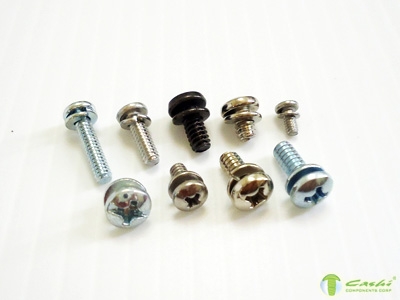
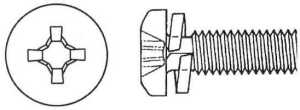
Pre-Assembled Screw and Spring Washer
The spring washer is assembled with the screw during production, eliminating the need to separately pick up or install the washer during assembly. This helps reduce material preparation and assembly steps.
Reduces Missing Parts and Washer Loss
Because the washer is retained on the screw, it is less likely to fall off during transportation, feeding, or assembly. This helps reduce missing spring washers, washers dropping into equipment, or discrepancies in component quantities.
Improves High-Volume Assembly Efficiency
Operators can handle the complete fastener as a single component without manually adding the washer, making it suitable for mass production, automated fastening, and assembly lines with demanding cycle-time requirements.
Provides Auxiliary Anti-Loosening Performance
After tightening, the spring washer generates elastic pressure and increases friction at the contact surface, helping reduce the possibility of screw loosening under general operating conditions.
A spring washer is an auxiliary anti-loosening feature. For high-vibration, impact, or safety-critical applications, additional locking methods should still be evaluated according to actual operating conditions.
Simplifies Parts Management
Combining the screw and spring washer into a single part number can simplify purchasing, inventory control, material issuing, and production-line preparation while reducing the risk of mixing components or material shortages.
Suitable for Automated Feeding and Fastening
The pre-assembled structure helps reduce problems such as loose washers jamming in vibratory bowls, feeding tracks, or automatic fastening equipment, as well as incorrect washer orientation, making it well suited for automated production processes.
Multiple Head Types and Thread Specifications Available
Different screw head types, drive styles, thread specifications, and spring washer dimensions can be selected according to assembly tools, product appearance, available installation space, and fastening requirements.
Multiple Material and Surface Treatment Options
Depending on strength, rust resistance, corrosion resistance, appearance, and operating environment requirements, carbon steel, stainless steel, or alloy steel can be selected together with zinc plating, nickel plating, black oxide, passivation, or other suitable surface treatments.
Customization Based on Drawings and Samples
W/SPRING WAS. products can be customized according to customer drawings or samples, including screw head type, drive type, thread diameter, thread pitch, length, washer type, material, tolerances, and surface treatment to meet different assembly requirements.
Common Applications
W/SPRING WAS. can be used in:
- Electronic and electrical equipment
- Machinery and automation equipment
- Automotive and motorcycle components
- Enclosures, cabinets, and sheet metal structures
- Home appliances and consumer products
- Telecommunications equipment
- Instruments and precision equipment
- Furniture and general hardware assemblies
- Production lines requiring high-volume or automated fastening
Key Considerations When Selecting W/SPRING WAS.
Before selection, confirm that the screw thread diameter, thread pitch, length, head type, and drive type meet the assembly requirements. The inner diameter, outside diameter, and thickness of the spring washer should also be checked to ensure compatibility with the contact surface.
Spring washers require a sufficient supporting surface to function properly. If the fastening hole is too large, the workpiece material is relatively soft, or the contact surface is prone to deformation, a combination screw with both a flat washer and spring washer may be further evaluated.
For applications involving severe vibration, repeated impact, high temperatures, or safety-critical structures, spring washers alone should not be relied upon for anti-loosening. Thread-locking adhesive, nylon lock nuts, all-metal locking structures, or other appropriate fastening methods should also be considered.
After repeated assembly and disassembly, the spring washer should be inspected for flattening, deformation, cracking, or loss of elasticity. If the washer can no longer return to its original shape, replacement with a new component is recommended.


