


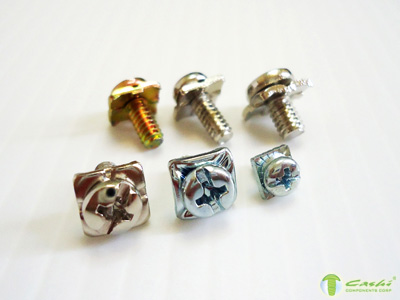
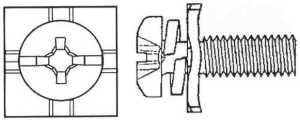
Pre-Assembled Screw and Square Washer
The square washer is installed and retained on the screw during production, eliminating the need to prepare or position the washer separately during assembly. This helps reduce assembly steps and improve operating efficiency.
Increases the Contact Area
Square washers generally provide a larger flat surface area, increasing the contact area between the screw head and the workpiece and allowing fastening force to be distributed more evenly.
Compared with a round washer of a similar overall diameter, the four corners of a square washer can extend the supporting area further, making it suitable for applications requiring a larger bearing surface.
Helps Distribute Fastening Pressure
The larger contact area helps reduce pressure concentration around the edge of the screw head or mounting hole, lowering the possibility of indentation, denting, or localized deformation in thin sheets, plastic parts, wood, or other relatively soft workpieces.
Actual load-distribution performance will still depend on the workpiece material, thickness, hole diameter, and tightening torque.
Can Be Used with Square Holes or Grooves for Positioning
The square profile can fit into square holes, guide grooves, frames, or other restricting structures. In certain product designs, this can help control washer orientation and reduce rotation or displacement during tightening.
Actual positioning performance should be confirmed according to the washer dimensions, workpiece groove dimensions, and mating tolerances.
Can Provide Auxiliary Anti-Rotation Performance
When the square washer is seated in a matching square recess or constrained by surrounding structures, its four edges can provide an anti-rotation effect and help maintain component orientation and installation position.
If a flat square washer is used without any restricting structure, its primary functions remain pressure distribution and increasing the supporting area.
Helps Protect the Workpiece Surface
The square washer separates the screw head from the workpiece and helps reduce direct friction against the contact surface during tightening, making it suitable for applications where scratches or indentation should be minimized.
Reduces the Risk of Missing or Dropped Washers
Because the washer is retained on the screw, it helps reduce missing washers, dropped parts, size mix-ups, or incorrect orientation during manual assembly. This supports greater assembly consistency in high-volume production.
Improves High-Volume Assembly Efficiency
Operators only need to handle one complete fastener assembly, eliminating the need to separately pick up the screw and square washer. This makes W/SPW.&SQW./W suitable for mass production and applications with demanding assembly cycle times.
Simplifies Purchasing and Inventory Management
Integrating the screw and square washer into a single part number can reduce the number of items that need to be managed during purchasing, receiving, material issuing, and production-line preparation, helping lower the risk of component shortages or incorrect specification matching.
Customization Based on Drawings and Samples
W/SPW.&SQW./W products can be customized according to customer engineering drawings or physical samples, including screw head type, drive type, thread diameter, thread pitch, length, washer side length, thickness, center hole diameter, bent corners, serrations, positioning structures, materials, tolerances, and surface treatments.
Common Applications
W/SPW.&SQW./W is commonly used in:
- Sheet metal, enclosures, and cabinet structures
- Machinery and automation equipment
- Electronic and electrical equipment
- Automotive and motorcycle components
- Furniture and wooden products
- Construction and general hardware
- Home appliances and consumer products
- Thin sheets, plastic components, and relatively soft workpieces
- Assemblies with square holes, guide grooves, or positioning structures
- Mass-production and general assembly operations
Key Considerations When Selecting W/SPW.&SQW./W
Before selection, confirm the screw thread diameter, thread pitch, length, head type, and drive type. The square washer side length, thickness, center hole diameter, and installation orientation should also be checked against the workpiece structure.
Square washers require a relatively large flat installation area. If nearby flanges, bent edges, wires, or surrounding components are present, the four corners of the washer should be checked in advance to avoid interference.
If the square washer is used with a square hole or groove for positioning, the dimensional tolerance between the washer and the mating feature should be carefully controlled. Excessive clearance may cause movement or misalignment, while insufficient clearance may make installation difficult or impossible.
The primary functions of a square washer are generally to increase the supporting area, distribute pressure, and assist with positioning. It does not necessarily provide anti-loosening performance on its own. For applications involving vibration, impact, or repeated operation, serrated structures, spring washers, lock nuts, thread-locking compounds, or other anti-loosening methods should be considered as required.
For workpieces made from relatively soft or thin materials, appropriate tightening torque should also be controlled to prevent the washer edges or flat surface from damaging or deforming the workpiece.


