


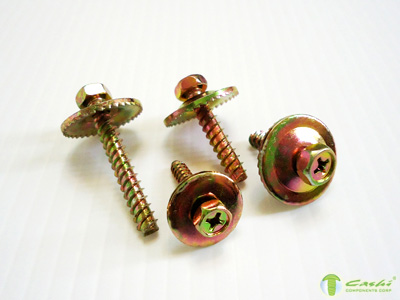
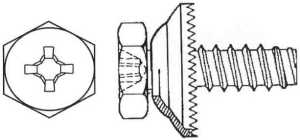
Pre-Assembled Screw and Conical Washer
The conical washer is installed and retained on the screw during manufacturing, eliminating the need to prepare or position the washer separately during assembly. This helps reduce assembly steps and improve operating efficiency.
Conical Structure Provides Axial Spring Force
When compressed, the conical washer generates an elastic reaction force that creates continuous axial pressure between the screw and the workpiece, helping maintain the fastening condition of the joint.
Actual spring force depends on the washer material, thickness, inner and outside diameters, free height, and compression amount, and should be selected according to actual product load requirements.
Helps Maintain Screw Preload
When the clamping thickness changes due to prolonged loading, material settling, or slight surface deformation, the conical washer can compensate for part of the displacement through elastic deformation, helping reduce rapid loss of preload.
Compensates for Dimensional Changes Caused by Thermal Expansion and Contraction
In equipment exposed to temperature variations, the conical washer can absorb slight displacement caused by thermal expansion and contraction within a certain range, helping maintain pressure at the joint.
Actual compensation capability should still be evaluated according to the temperature range, material coefficient of thermal expansion, and washer compression travel.
Provides Auxiliary Anti-Loosening Performance
The elastic reaction force of the conical washer continuously acts against the screw head, helping maintain pressure at the joint and reducing the possibility of screw loosening under general vibration or dynamic load conditions.
A conical washer is primarily a preload and auxiliary anti-loosening component. For severe vibration, heavy impact, or safety-critical applications, additional locking measures should still be evaluated.
Compact Design with Higher Load Capacity
Conical washers can provide elastic loading within a relatively small axial space, making them suitable for assemblies with limited installation height that still require elastic preload or load compensation.
Reduces Missing Washers and Incorrect Orientation
Because the washer is retained on the screw, it helps reduce missing washers, dropped components, specification mix-ups, or incorrect washer orientation during manual assembly, supporting greater consistency in high-volume production.
Improves High-Volume Assembly Efficiency
Operators only need to handle one complete fastener assembly and do not need to separately pick up the screw and conical washer, helping reduce handling steps and shorten assembly time.
Suitable for Automated Feeding and Fastening
The pre-assembled structure helps reduce problems such as loose washers flipping, overlapping, jamming, or falling off in vibratory bowls, feeding tracks, or automatic fastening equipment, making it suitable for automated assembly processes.
Actual feeding stability should still be tested according to the screw head type, screw length, washer outside diameter, free height, and equipment specifications.
Simplifies Purchasing and Inventory Management
Integrating the screw and conical washer into a single part number can reduce the number of items that need to be managed during purchasing, receiving, material issuing, and production-line preparation, helping lower the risk of shortages or incorrect specification matching.
Customization Based on Drawings and Samples
W/CON.WAS. products can be customized according to customer engineering drawings or physical samples, including screw head type, drive type, thread diameter, thread pitch, length, washer inner and outside diameters, thickness, free height, spring force, installation orientation, materials, tolerances, and surface treatments.
Common Applications
W/CON.WAS. is commonly used in:
- Machinery and automation equipment
- Automotive and motorcycle components
- Motors, fans, and transmission mechanisms
- Electronic and electrical equipment
- Enclosures, cabinets, and sheet metal structures
- Home appliances and consumer products
- Telecommunications and information equipment
- Instruments and precision equipment
- Joints exposed to temperature variations or material settling
- Assemblies requiring continuous preload or elastic compensation
- Mass-production and automated fastening lines
Key Considerations When Selecting W/CON.WAS.
Before selection, confirm the screw thread diameter, thread pitch, length, head type, and drive type. The conical washer inner diameter, outside diameter, thickness, free height, spring force, and installation orientation should also be checked against the product design.
Conical washers must operate within an appropriate compression range. If compression is insufficient, the required preload may not be achieved. If the washer is overtightened and remains completely flattened for an extended period, its elastic compensation capability may be reduced, potentially causing permanent deformation or fatigue damage.
The concave and convex orientation of the washer affects the contact position, spring travel, and load behavior. Installation direction should therefore be confirmed according to the product drawing, screw head geometry, and workpiece structure.
For applications involving high temperatures, corrosive environments, high loads, or repeated vibration, the washer material, temperature resistance, fatigue life, surface treatment, and actual load requirements should be further evaluated.
After repeated assembly and disassembly, the conical washer should be inspected for flattening, cracking, warping, wear, or reduced elasticity. If the washer can no longer return to its original conical shape, replacement with a new component is recommended.


