


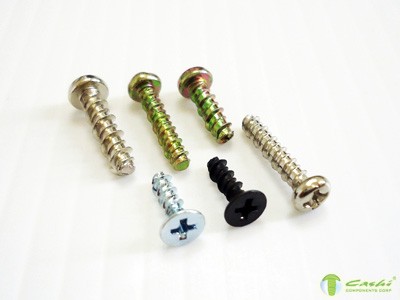
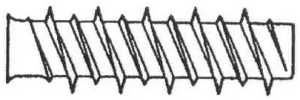
Alternating High and Low Thread Design
TWIN-HL uses alternating threads of different heights. During installation, the high threads establish the main engagement with the workpiece, while the low threads assist with lead-in and help control how the material around the hole deforms.
The actual height ratio and arrangement of the high and low threads should be confirmed according to the original product design and workpiece material.
Helps Reduce Driving Resistance
The low threads reduce the amount of simultaneous material displacement by the entire thread profile, allowing the screw to enter the pilot hole more easily and reducing the torque required during thread formation.
Driving resistance will still depend on pilot hole size, material hardness, screw outside diameter, and surface treatment.
High Threads Provide Primary Engagement
The high threads penetrate deeper into the workpiece material, increasing effective thread engagement depth and helping maintain pull-out strength and fastening stability.
Actual load capacity should be tested according to boss dimensions, material strength, thread pitch, and effective engagement length.
Suitable for Plastic Components
The high-low thread profile can be designed according to the characteristics of plastic materials, with adjustments to thread depth and material-displacement space. This makes TWIN-HL suitable for general plastic and engineering plastic housings, bosses, and components.
Before final selection, the plastic type, glass-fiber content, boss wall thickness, and material shrinkage characteristics should be confirmed.
Helps Reduce Plastic Boss Expansion
The alternating action of the high and low threads helps prevent excessive material compression at the same location. With the proper pilot hole size and fastening torque, this can help reduce the risk of boss expansion, stress whitening, or cracking.
Provides More Space for Material Displacement
The lower secondary threads between the high threads provide additional space for material movement and accommodation, helping reduce excessive compression of the workpiece during installation.
This feature can be particularly useful for plastics, wood, and certain softer materials.
Forms Internal Threads in a Pilot Hole
When driven into a properly sized pilot hole, TWIN-HL can cut or displace the hole wall with its high-low thread profile and form mating internal threads, reducing the need for a separate tapping operation.
May Eliminate the Need for a Separate Nut
TWIN-HL can be driven directly into the workpiece, making it suitable for one-sided assembly, structures where rear-side nut installation is not possible, or products with limited internal space.
Balances Pull-Out Strength and Driving Torque
By using the high threads for primary engagement and the low threads to reduce material resistance, a properly designed TWIN-HL screw can balance pull-out strength with manageable driving torque, providing greater flexibility when setting mass-production fastening parameters.
Actual performance should be confirmed through driving torque, stripping torque, and pull-out tests.
Helps Reduce Material Cracking
When designed as a thread-forming type, the high-low thread profile allows the material to deform progressively, helping reduce chip generation and lowering the risk of cracking in brittle plastics or thin-wall bosses caused by concentrated stress.
Suitable for High-Volume Production and Automated Fastening
TWIN-HL screws with consistent specifications can be used with vibratory bowls, feeding tracks, and automatic screw-fastening equipment, making them suitable for high-volume assembly of electronics, home appliances, automotive interior components, and plastic parts.
During automated fastening, rotational speed, downward force, driving depth, and shut-off torque should be properly controlled.
Multiple Head and Point Designs Available
Depending on product appearance, installation tools, workpiece material, and available assembly space, TWIN-HL screws can be designed with pan heads, countersunk heads, hex heads, and other head styles, together with pointed ends, flat ends, pilot points, or cutting points.
Multiple Materials and Surface Treatments Available
Depending on strength, rust resistance, corrosion resistance, and operating environment, carbon steel, alloy steel, or stainless steel can be selected together with zinc plating, nickel plating, black oxide, phosphate coating, passivation, or other surface treatments.
Customization Based on Drawings and Samples
TWIN-HL screws can be customized according to customer engineering drawings or physical samples, including screw head type, drive recess, thread diameter, thread pitch, high-to-low thread height ratio, overall length, point structure, material, hardness, tolerances, heat treatment, and surface treatment.
Common Applications
TWIN-HL screws are commonly used in:
- General plastic housings and components
- Engineering plastic bosses and structural parts
- Electronic and electrical equipment
- Home appliances and consumer products
- Automotive and motorcycle interior components
- Telecommunications and information equipment
- Instruments and precision equipment
- Toys and household products
- Wooden furniture and decorative hardware
- Aluminum alloy and zinc alloy die-cast parts
- One-sided assembly locations or areas where rear-side nut installation is difficult
- Mass-production and automated fastening lines
Key Considerations When Selecting TWIN-HL
Before selection, confirm the dimensions, arrangement, and thread pitch of the high and low threads. Different manufacturers or product drawings may define high-low threads differently, so the product name alone should not be used to determine the actual thread geometry.
The workpiece material, hardness, ductility, boss outside diameter, wall thickness, pilot hole depth, and effective engagement length should be confirmed in advance. For plastic applications in particular, whether the material contains glass fiber or other fillers should also be checked, as the material formulation can significantly affect driving torque and cracking risk.
If the pilot hole is too small, material displacement and driving torque may become excessive, potentially causing boss expansion, stress whitening, cracking, or screw breakage. If the pilot hole is too large, the high threads may not engage sufficiently, resulting in free spinning, thread stripping, or reduced pull-out strength.
The boss outside diameter and wall thickness must provide sufficient surrounding material. Even with a high-low thread design, an excessively thin boss, oversized screw diameter, or fastening position too close to the workpiece edge may still cause cracking.
For blind-hole applications, sufficient clearance should be provided between the screw point and the bottom of the hole to prevent a sudden increase in tightening torque if the point bottoms out.
Fastening tools should be set to appropriate rotational speed, downward force, and shut-off torque. For plastic applications, excessive speed may generate frictional heat, causing the hole wall to soften, melt, or lose thread retention strength.
TWIN-HL screws are not intended for unlimited repeated assembly and disassembly. Repeated removal may wear the internal threads in the workpiece or enlarge the hole, reducing driving torque and pull-out strength during subsequent installations.
Before mass production, driving torque, tightening torque, stripping torque, failure torque, pull-out strength, and boss-cracking tests are recommended to confirm that the selected pilot hole, thread profile, and fastening parameters provide an adequate process safety margin.


