


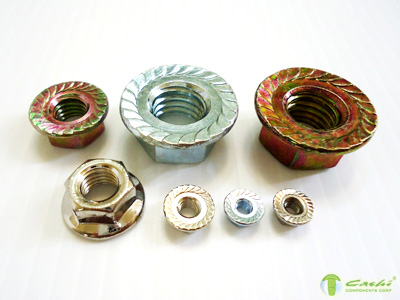
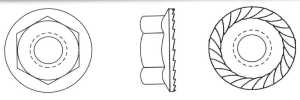
Integrated Flange Design Increases Contact Area
The integrated flange at the base of the nut increases the contact area with the workpiece, helping distribute fastening force more evenly and reducing stress concentration around the nut edge or mounting hole.
Helps Distribute Fastening Pressure
When the workpiece is relatively thin, the hole diameter is larger, or a more stable supporting surface is required, the flange can help distribute the pressure applied by the nut and reduce the possibility of localized indentation or deformation.
Actual load-bearing performance should still be evaluated according to the workpiece material, thickness, hole diameter, and tightening torque.
May Reduce the Need for Additional Washers
Flange nuts combine the nut and supporting surface into a single component. In certain assembly designs, this may reduce the need for separate flat washers, lowering the number of components and simplifying material preparation and assembly procedures.
Whether a washer can be omitted should still be confirmed according to the product structure, hole dimensions, and load conditions.
Improves Assembly Efficiency
The integrated design reduces the need to position a separate washer during installation, making flange nuts suitable for mass production, automated assembly, and applications where shorter assembly time is required.
Improves Installation Stability
The wider flange provides a larger supporting area between the nut and the workpiece, helping reduce tilting during tightening or the possibility of the nut sinking into the area around the mounting hole. This helps maintain a more stable assembly position.
Available with Plain or Serrated Flange Designs
Plain flange nuts are suitable for applications where a larger bearing surface and protection of the contact surface are important. Serrated flange nuts use teeth on the underside of the flange to increase friction and gripping action, making them suitable for applications requiring enhanced anti-loosening performance.
Hexagonal Shape for Easy Tightening
The hexagonal nut body can be tightened using open-end wrenches, box-end wrenches, sockets, or pneumatic tools, making flange nuts suitable for manual assembly, automated production, and maintenance operations.
Multiple Material and Surface Treatment Options
Depending on strength, rust resistance, corrosion resistance, appearance, and operating environment requirements, flange nuts can be produced in carbon steel, stainless steel, or other metal materials with suitable surface treatments.
Customization Based on Drawings and Samples
Flange nuts can be customized according to customer drawings or samples, including thread diameter, thread pitch, nut height, width across flats, flange outside diameter, flange thickness, serrated surface design, material, tolerances, and surface treatment to meet different assembly requirements.
Common Applications
Flange nuts can be used in:
- Automotive and motorcycle components
- Machinery and automation equipment
- Electronic and electrical equipment
- Sheet metal and metal frames
- Furniture and hardware accessories
- Agricultural and gardening machinery
- Sports equipment
- Industrial equipment and general assembly structures
Key Considerations When Selecting Flange Nuts
Before selection, confirm that the screw thread diameter, thread pitch, metric or imperial specification, and nut dimensions are compatible. The flange outside diameter should also be checked against the available installation space to avoid interference with surrounding components.
If the workpiece surface is painted, plated, or has specific appearance requirements, a plain flange type is generally more suitable, and the contact surface should be checked for possible indentation. Although serrated flange nuts provide improved anti-loosening performance, the serrations may scratch coatings or leave marks on the workpiece surface.
For applications involving high loads, continuous vibration, or critical structures, the nut material, strength grade, tightening torque, and effective thread engagement length should also be confirmed. Additional anti-loosening measures may be required when necessary.


