


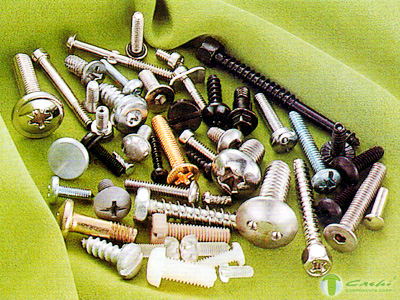
Custom-Designed According to Product Structure
Special Screws can be adjusted according to internal equipment space, workpiece thickness, hole location, fastening depth, and appearance requirements, allowing them to fit assembly locations where standard screws cannot be used directly.
Supports Development from Drawings and Samples
Dimensions and manufacturing processes can be evaluated according to customer-provided 2D engineering drawings, 3D models, or physical samples, making Special Screws suitable for replacement parts, new product development, and special mechanism design.
If only a physical sample is available, material, hardness, tolerances, and functional requirements should still be confirmed to avoid reproducing only the appearance without meeting actual performance requirements.
Integrates Multiple Mechanical Functions
In addition to basic fastening, Special Screws can integrate positioning, guiding, stopping, spacing, anti-rotation, pivot-shaft, or anti-loosening functions, reducing the need for separate locating pins, sleeves, washers, and other auxiliary components.
The actual functions that can be integrated should be evaluated according to load conditions, manufacturing limitations, and safety requirements.
Suitable for Restricted or Special Installation Spaces
Head height, outside diameter, drive recess, and tool access direction can be adjusted for applications where surrounding components are densely arranged, head clearance is limited, or standard tools are difficult to use.
Multiple Head and Drive Recess Options
Hex socket, external hex, Torx, square drive, tamper-resistant recesses, and other special drive structures can be designed according to tightening torque, appearance, anti-tampering, and automation requirements.
Tamper-resistant drive types usually require dedicated tools, so maintenance and after-sales service requirements should also be considered before selection.
Thread Structure Can Be Adjusted According to Material
Machine threads, self-tapping threads, high-low threads, triangular threads, coarse threads, fine threads, and other special thread profiles can be designed according to whether the mating workpiece is metal, plastic, wood, or a die-cast component, improving compatibility between the screw and workpiece.
Multiple Sections and Stepped Structures Available
A Special Screw can incorporate different outside diameters, thread profiles, smooth sections, shoulders, or reduced-diameter sections along the same shank, allowing one component to provide positioning, guiding, and fastening functions.
Materials and Strength Can Be Selected According to Load
Carbon steel, alloy steel, stainless steel, or other materials can be selected according to axial tensile loads, radial shear loads, torsional loads, vibration, and fatigue conditions. Heat treatment can also be applied to improve strength and wear resistance.
Multiple Surface Treatments for Different Environments
Depending on rust resistance, corrosion resistance, electrical conductivity, insulation, wear resistance, and appearance requirements, Special Screws can be finished with zinc plating, nickel plating, black oxide, phosphate coating, passivation, or other specified surface treatments.
For coastal, outdoor, or chemical environments, the base material, coating thickness, and risk of galvanic corrosion between dissimilar metals should also be evaluated.
Suitable for Automated Assembly Development
Head type, center of gravity, overall length, point lead-in, and drive recess can be designed according to the requirements of vibratory bowls, feeding tracks, robotic systems, and automatic fastening equipment to improve feeding and fastening compatibility.
Actual samples should be tested with the intended feeding and fastening equipment before mass production.
Prototype Sampling and Functional Verification Available
Prototype samples can be produced before mass production to verify dimensional fit, driving torque, clamping performance, assembly interference, appearance, and actual function. Final specifications can then be adjusted according to test results.
Suitable for Both Low-Volume and High-Volume Production
Depending on product structure and quantity, machining can be used for low-volume prototype production, while cold forging, thread rolling, and dedicated tooling can be developed for mass production to balance dimensional accuracy, production efficiency, and manufacturing cost.
Helps Reduce Assembly Complexity
If a Special Screw integrates washers, shoulders, sleeves, positioning sections, or anti-loosening features, it can reduce component count, assembly steps, and parts-management requirements.
Common Special Structures
Special Head Screws
Low-profile heads, thin heads, large heads, eccentric heads, special-shaped heads, or other non-standard head designs can be manufactured according to installation-space or appearance requirements.
Stepped and Shoulder Screws
Different shank diameters or unthreaded shoulder sections can be incorporated for positioning, rotation, sliding, stopping, and spacing control.
Special Thread Screws
High-low threads, triangular threads, twin-start threads, left-hand threads, self-tapping threads, or other special thread profiles can be used to match different workpiece materials and fastening requirements.
Tamper-Resistant Screws
Special drive recesses or one-way structures can reduce the possibility of removal with ordinary tools, making them suitable for public facilities, equipment enclosures, and security-related applications.
Anti-Loosening Screws
Thread-locking compounds, nylon patches, serrations beneath the head, special thread profiles, or pre-assembled washers can be used to improve retention in vibration-prone environments.
Combination Screws
Flat washers, spring washers, toothed washers, or other components can be pre-assembled with the screw to reduce the possibility of missing or incorrectly installed parts on the assembly line.
Common Applications
Special Screws are commonly used in:
- Automotive and motorcycle components
- Electronic and electrical equipment
- Home appliances and consumer products
- Machinery and automation equipment
- Robotics and precision mechanisms
- Telecommunications and information equipment
- Medical devices and instrumentation
- Aerospace and transportation equipment components
- Molds, jigs, and fixtures
- Plastic housings and die-cast parts
- Furniture, architectural, and decorative hardware
- Tamper-resistant, anti-loosening, and special safety structures
- Installation locations where standard screws cannot be used
- Mass-production and automated fastening lines
Information Required Before Developing a Special Screw
Before requesting a quotation or beginning Special Screw development, it is recommended to prepare:
- Complete 2D engineering drawings or 3D models
- Existing screws or physical samples
- Screw head type and drive recess
- Thread diameter, thread pitch, thread profile, and thread direction
- Overall length, shank diameter, and dimensions of each section
- Mating workpiece material, thickness, and hole dimensions
- Primary screw function and load conditions
- Installation tools and fastening method
- Material, hardness, and strength requirements
- Surface treatment and appearance requirements
- Dimensional tolerances and inspection standards
- Operating temperature, corrosive conditions, and vibration environment
- Whether anti-loosening, tamper-resistant, or sealing functions are required
- Prototype quantity and estimated mass-production quantity
- Packaging, feeding, and automated fastening requirements
Key Considerations When Selecting a Special Screw
Special Screw specifications generally cannot be determined from the product name alone. Complete engineering drawings, 3D models, or physical samples should be used as the basis for development. Drawings should clearly specify dimensions, tolerances, materials, heat treatment, surface treatment, and functional requirements.
If the Special Screw must withstand tensile loads, shear loads, bending moments, vibration, or fatigue loading, the product design should confirm the actual load conditions and safety factor rather than selecting the screw based only on its external dimensions.
Custom thread profiles should be matched to the workpiece hole diameter, material, and effective engagement depth. Incorrect pilot-hole or internal-thread dimensions may cause excessive driving torque, thread stripping, workpiece cracking, or insufficient pull-out strength.
If the shank includes stepped, shoulder, or reduced-diameter sections, the outside diameter, length, fillets, and relief grooves of each section should be checked for possible interference with the workpiece and for potential stress concentration.
Material and heat treatment should provide an appropriate balance between surface hardness and core toughness. Insufficient hardness may cause thread wear or deformation, while excessive hardness with insufficient toughness may lead to brittle fracture during fastening or loading.
Surface treatment can affect thread dimensions, coefficient of friction, and tightening torque. For precision threads or small screws, coating thickness should be included in tolerance calculations and thread-gauge inspection.
Before mass production, prototype assembly, dimensional inspection, tightening torque, tensile strength, shear strength, durability, vibration resistance, corrosion resistance, and automated feeding tests are recommended to confirm that the final product specifications meet actual operating requirements.


