


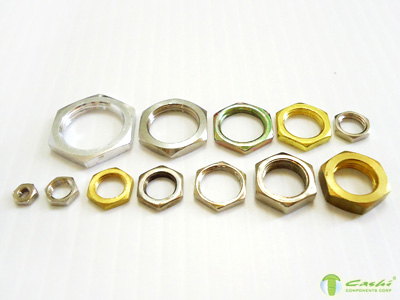
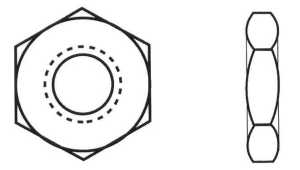
Thin Design Saves Assembly Space
Compared with standard hex nuts, thin hex nuts have a lower overall height, reducing the amount of space required at the fastening point. They are suitable for installation inside equipment, mechanical assemblies, and other locations where available height is limited.
Helps Reduce Overall Product Height
For applications where the nut should not protrude significantly from the component surface, the thin profile helps reduce the assembled height, resulting in a more compact structure and a cleaner finished appearance.
Can Be Used in Double-Nut Locking Applications
Thin hex nuts can be used together with standard hex nuts. By tightening the two nuts against each other, friction between the threads is increased, helping reduce the possibility of loosening caused by equipment vibration or prolonged operation.
The actual anti-loosening performance should still be evaluated according to the applied load, vibration frequency, and installation method.
Hexagonal Shape for Easy Tool Operation
The hexagonal shape allows installation and removal with open-end wrenches, box-end wrenches, or socket tools, making thin hex nuts suitable for manual assembly, equipment adjustment, and maintenance work.
Suitable for Position Adjustment and Component Location
Thin hex nuts can be used on threaded rods, adjustment screws, or mechanical mechanisms for position limiting, spacing adjustment, or component positioning, making it easier to control the installation position of components along a threaded section.
Multiple Material and Surface Treatment Options
Depending on requirements for strength, rust resistance, corrosion resistance, electrical conductivity, appearance, and operating environment, thin hex nuts can be produced in carbon steel, stainless steel, brass, aluminum, and other materials, with suitable surface treatments.
Customization Based on Drawings and Samples
Thin hex nuts can be customized according to customer drawings or samples, including thread specifications, nut thickness, width across flats, material, tolerances, and surface treatments, to match the assembly conditions of different products and equipment.
Common Applications
Thin hex nuts can be used in:
- Machinery and automation equipment
- Electronic and electrical products
- Automotive and motorcycle components
- Furniture and hardware accessories
- Instruments and precision equipment
- Threaded rods and adjustment screws
- Height-restricted assembly structures
- Double-nut anti-loosening assemblies
Key Considerations When Selecting Thin Hex Nuts
When selecting thin hex nuts, first confirm the screw thread diameter, thread pitch, metric or imperial thread specification, and nut thickness to ensure compatibility with the assembly requirements.
Because thin hex nuts have a lower height, the number of effective threads engaged with the screw is generally lower than with standard hex nuts. As a result, their ability to withstand axial loads and tightening torque may differ. For high-load, continuously vibrating, or critical structural applications, the material, strength grade, effective thread engagement length, and anti-loosening method should be carefully evaluated.
If the primary requirement is to withstand higher fastening loads, a standard-height hex nut should generally be evaluated first. If the application involves space limitations, position adjustment, or double-nut locking, thin hex nuts can provide greater structural advantages.


