


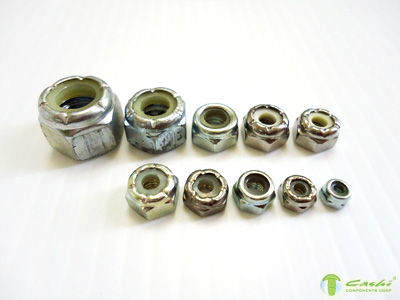
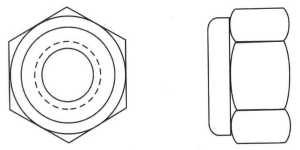
Nylon Insert Design for Improved Locking Performance
When the screw is threaded into the nut, the nylon insert is compressed by the threads and creates frictional resistance. This increases rotational resistance and helps reduce loosening caused by vibration, impact, or repeated operation.
May Reduce the Need for Additional Locking Washers
Because nylon lock nuts have an integrated locking structure, they may reduce the need for spring washers, lock washers, or other auxiliary locking components in certain assembly conditions, helping simplify the overall assembly.
Whether additional locking components can be omitted should still be evaluated according to equipment load, vibration level, and safety requirements.
Helps Protect the Screw Threads During Fastening
Because the nylon insert is non-metallic, it can increase friction without significantly damaging the screw threads. This makes nylon lock nuts suitable for applications that require stable fastening while maintaining thread integrity.
Suitable for General Vibration Environments
Nylon lock nuts are suitable for machinery, automotive and motorcycle components, electronic and electrical products, and other assemblies exposed to general vibration or movement. They help maintain a stable fastening condition during operation.
Hexagonal Shape for Easy Installation
The hexagonal nut body can be tightened using open-end wrenches, box-end wrenches, or socket tools, making it suitable for manual assembly, automated equipment, and maintenance operations.
Multiple Material and Surface Treatment Options
Depending on strength, rust resistance, corrosion resistance, and appearance requirements, nylon lock nuts can be produced in carbon steel, stainless steel, and other materials, with surface treatments such as zinc plating, nickel plating, black oxide, or passivation.
Customization Based on Drawings and Samples
Nylon lock nuts can be customized according to customer drawings or samples, including thread diameter, thread pitch, nut height, width across flats, nylon insert structure, material, tolerances, and surface treatment, to meet different product assembly requirements.
Common Applications
Nylon lock nuts can be used in:
- Machinery and automation equipment
- Automotive and motorcycle components
- Electronic and electrical equipment
- Furniture and hardware accessories
- Sports equipment
- Agricultural and gardening machinery
- Instruments and general industrial equipment
- Assemblies exposed to vibration or movement
Key Considerations When Selecting Nylon Lock Nuts
Before selection, confirm that the screw thread diameter, thread pitch, metric or imperial specification, and nut dimensions are compatible. The screw should also pass completely through the nylon insert after installation to generate the intended locking resistance.
The nylon insert can be affected by temperature, chemicals, and repeated use. For applications involving high temperatures or exposure to oils, solvents, or corrosive chemicals, the suitability of the nylon material should be confirmed in advance.
Although nylon lock nuts can be reused after removal, repeated tightening and loosening may gradually wear the nylon insert and reduce its locking resistance. For critical structures, safety-related components, or equipment requiring stable torque performance, replacement with a new nut should be considered based on actual operating conditions.
For applications involving higher temperatures, severe vibration, or stricter anti-loosening requirements, all-metal lock nuts, thread-locking compounds, or other locking structures should be further evaluated.


