


Creates Stable Metal Internal Threads in Base Materials
Clinching nuts create durable metal internal threads in plastics, wood, and other relatively soft materials. This helps reduce problems such as thread wear, stripping, or insufficient fastening strength that may occur when threads are formed directly in the base material.
Suitable for Repeated Assembly and Disassembly
Compared with driving screws directly into plastic or wood, metal internal threads can better withstand repeated tightening and removal, making clinching nuts suitable for products that require regular maintenance, component replacement, or repeated assembly.
External Serrations Improve Anti-Rotation Performance
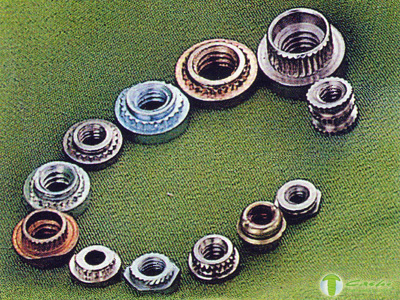
The outer surface of the nut can feature knurls, serrations, barbs, or grooves that engage with the base material after installation. This helps prevent the nut from rotating together with the screw during tightening.
Improves Pull-Out Resistance
A properly designed external structure can improve the retention of the nut within the workpiece and reduce the possibility of pull-out or loosening under tensile loads. Actual pull-out resistance should be evaluated according to the strength of the base material, hole diameter, installation depth, and nut design.
Saves External Installation Space
Clinching nuts can be embedded or inserted into the workpiece, reducing external protrusion and creating a cleaner finished surface. This makes them suitable for compact assemblies or products where appearance is important.
Multiple Installation Methods Available
Depending on the base material and production process, installation methods such as press-in, hammer-in, heat-set, or insert molding can be selected to suit different product structures and mass-production requirements.
Multiple Material and Structural Options
Depending on strength, electrical conductivity, rust resistance, corrosion resistance, and cost requirements, clinching nuts can be made from carbon steel, stainless steel, brass, aluminum, and other materials. Different outside diameters, lengths, flange designs, and knurling structures are also available.
Customization Based on Drawings and Samples
Clinching nuts can be customized according to customer drawings or samples, including thread specifications, outside diameter, length, hole fit, knurling pattern, barb direction, flange dimensions, material, tolerances, and surface treatment.
Common Applications
Clinching nuts can be used in:
- Plastic injection-molded components
- Electronic and electrical enclosures
- Furniture and wooden products
- Home appliances and consumer products
- Automotive and motorcycle interior components
- Medical and precision instruments
- Telecommunications equipment and mechanical enclosures
- Assemblies requiring repeated disassembly and reassembly
Key Considerations When Selecting Clinching Nuts
Before selection, confirm the type and hardness of the base material, workpiece thickness, prepared hole diameter, and installation method. If the prepared hole is too small, installation may cause cracking, deformation, or excessive internal stress in the base material. If the hole is too large, anti-rotation performance and pull-out resistance may be insufficient.
For heat-set installation, heating temperature, insertion speed, and installation depth should be carefully controlled to avoid excessive melting, material overflow, or misalignment of the nut. For press-in or hammer-in installation, the base material should have sufficient toughness to prevent cracking during installation.
A larger nut length or outside diameter is not always better. The appropriate specification should be selected according to workpiece thickness, edge distance, load direction, and available assembly space. For high-load, continuously vibrating, or critical structural applications, torque resistance, pull-out strength, and actual tightening torque should be further evaluated.


