


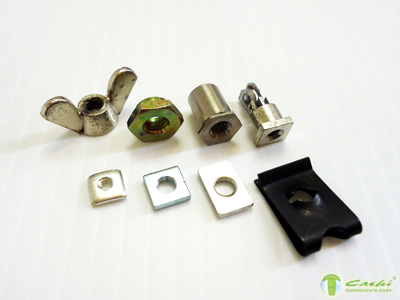
Customized Production Based on Drawings and Samples
Special nuts can be developed according to customer engineering drawings, physical samples, or assembly requirements. Dimensions, thread pitch, shape, materials, tolerances, and functional features can be customized to meet product designs that cannot be accommodated by standard nuts.
Designed for Special Assembly Space
Nut height, width across flats, outside diameter, flange dimensions, and tool-access features can be adjusted according to internal equipment space, surrounding component interference, and fastening tool limitations, allowing the nut to better fit actual installation conditions.
Multiple Fastening Functions Can Be Integrated
Anti-loosening, anti-rotation, positioning, stopping, sealing, guiding, or supporting functions can be integrated into a single nut structure, helping reduce the number of additional components and simplify product assembly and parts management.
Various Custom Shapes Available
In addition to conventional hexagonal shapes, special nuts can be produced in round, square, long, thin, flanged, stepped, slotted, or other irregular configurations to match different product appearances and mechanical designs.
Wide Range of Material Options
Depending on load, strength, weight, rust resistance, corrosion resistance, electrical conductivity, temperature resistance, and processing requirements, materials such as carbon steel, alloy steel, stainless steel, copper, brass, or aluminum can be selected.
Various Surface and Heat Treatment Options
Depending on the operating environment and product requirements, special nuts can be treated with zinc plating, nickel plating, chrome plating, black oxide, passivation, or other surface finishes. Heat treatment processes such as tempering, carburizing, or quenching can also be evaluated to improve hardness, wear resistance, or corrosion resistance.
Production Processes for Different Quantities and Requirements
Depending on the product shape, precision requirements, and order quantity, processes such as cold forging, stamping, machining, or other manufacturing methods can be evaluated. Flexible machining may be suitable for small-volume prototypes, while tooling and automated production can be further considered for high-volume manufacturing.
Improves Assembly Efficiency and Product Consistency
By designing nuts to match the actual product structure, installation interference, incorrect component use, and assembly difficulties can be reduced. This also helps improve dimensional consistency and assembly efficiency during mass production.
Common Special Structures
Special Nuts can be designed with:
- Non-standard hexagonal or custom-shaped profiles
- Special heights, outside diameters, or widths across flats
- Thin, long, or stepped structures
- Flanged, serrated, or anti-slip surfaces
- Knurled, barbed, or anti-rotation structures
- Welding tabs, positioning pins, or guiding structures
- Combined internal and external threads
- Left-hand threads, fine threads, or special thread pitches
- Blind holes, through holes, or partial threads
- Grooves, slots, or tool-access holes
The actual structure should be confirmed according to the product drawing, fastening method, and operating environment.
Common Applications
Special Nuts can be used in:
- Automotive and motorcycle components
- Machinery and automation equipment
- Electronic, electrical, and telecommunications equipment
- Sheet metal, enclosures, and cabinet structures
- Home appliances and consumer products
- Furniture and construction hardware
- Medical and precision instruments
- Sports equipment and outdoor equipment
- Aerospace, energy, and specialized industrial equipment
- Various customized mechanisms and assembly components
Information Required Before Developing Special Nuts
Before developing or requesting a quotation for Special Nuts, it is recommended to prepare the following information:
- Product drawings with complete dimensions
- Thread diameter, thread pitch, and metric or imperial specifications
- Material and strength grade requirements
- Surface treatment and appearance requirements
- Dimensional tolerances and thread accuracy
- Actual operating environment and load conditions
- Assembly method and mating components
- Sample requirements and estimated order quantity
- Inspection, packaging, and delivery requirements
If complete drawings are not yet available, physical samples, assembly photos, mating screws, and application details can also be provided as references for preliminary specification evaluation.
Key Considerations When Selecting Special Nuts
Special Nuts involve more than simply modifying external dimensions. Effective thread engagement length, tightening torque, material strength, tolerance fit, and manufacturing feasibility must also be considered together. If the nut is used in high-load, continuously vibrating, high-temperature, corrosive, or safety-critical applications, further evaluation of strength, torque performance, anti-loosening capability, and durability is recommended.
Before mass production, prototype sampling and actual assembly testing are recommended to confirm compatibility between the nut, screw, workpiece, and installation tools. Final dimensions, tolerances, and production methods can then be determined based on the test results.


